mirror of
https://github.com/ipfs/kubo.git
synced 2026-02-24 11:57:44 +08:00
 f354fa849e
@maybebtc thoughts on this? dialing self should be **possible**, so we should in general test that we do consider that case, but not sure if this is good to expose to clients. thoughts? Btw, on why dialing self should be possible, we may create little protocols which we may have a node connect to self, say across its interfaces to test connectivity, etc... think of it like: > server localhost:1234 & > curl localhost:1234 |
||
|---|---|---|
| .. | ||
| conn | ||
| handshake | ||
| mock | ||
| swarm | ||
| interface.go | ||
| mux_test.go | ||
| mux.go | ||
| net.go | ||
| README.md | ||
Network
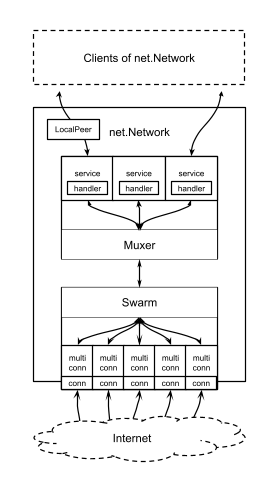
The IPFS Network package handles all of the peer-to-peer networking. It connects to other hosts, it encrypts communications, it muxes messages between the network's client services and target hosts. It has multiple subcomponents:
Conn- a connection to a single PeerMultiConn- a set of connections to a single PeerSecureConn- an encrypted (tls-like) connection
Swarm- holds connections to Peers, multiplexes from/to eachMultiConnMuxer- multiplexes betweenServicesandSwarm. HandlesRequet/Reply.Service- connects between an outside client service and Network.Handler- the client service part that handles requests
It looks a bit like this: