mirror of
https://github.com/ipfs/kubo.git
synced 2026-02-24 03:47:45 +08:00
| .. | ||
| backpressure | ||
| conn | ||
| handshake | ||
| mock | ||
| swarm | ||
| id_test.go | ||
| id.go | ||
| interface.go | ||
| mux_test.go | ||
| mux.go | ||
| net_test.go | ||
| net.go | ||
| README.md | ||

Network
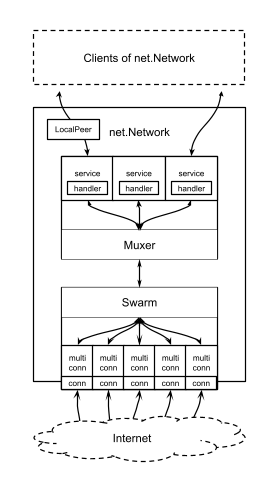
The IPFS Network package handles all of the peer-to-peer networking. It connects to other hosts, it encrypts communications, it muxes messages between the network's client services and target hosts. It has multiple subcomponents:
Conn- a connection to a single PeerMultiConn- a set of connections to a single PeerSecureConn- an encrypted (tls-like) connection
Swarm- holds connections to Peers, multiplexes from/to eachMultiConnMuxer- multiplexes betweenServicesandSwarm. HandlesRequet/Reply.Service- connects between an outside client service and Network.Handler- the client service part that handles requests
It looks a bit like this: